Scam Texts in 2026: Unpaid Tolls, Fake Traffic Court Summons and How to Spot Them
First it was unpaid tolls, now it's "final summons" texts with court seals and QR codes. Here's how the newest scam texts work, why they're so convincing, and what to do in the first hour if you already paid.
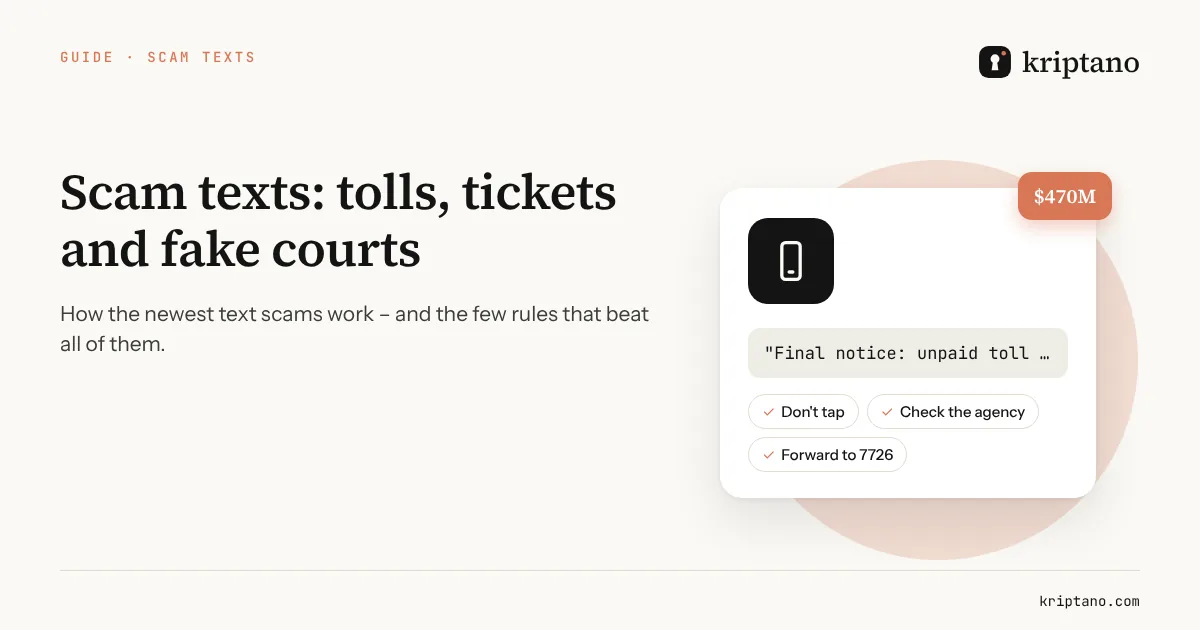
Your phone buzzes: “FINAL NOTICE – unpaid toll balance of $6.99. Pay today to avoid a $50 late fee and suspension of your registration.” A few weeks later the same trick comes back dressed as a court: a seal, a judge’s name, a case number and a QR code to “settle your traffic violation”. Scam texts like these are now among the most reported frauds in the US. This guide explains how the toll scam text and the traffic court summons scam work, the red flags that give them away, and what to do if you already paid.
Contents
Scam texts in numbers
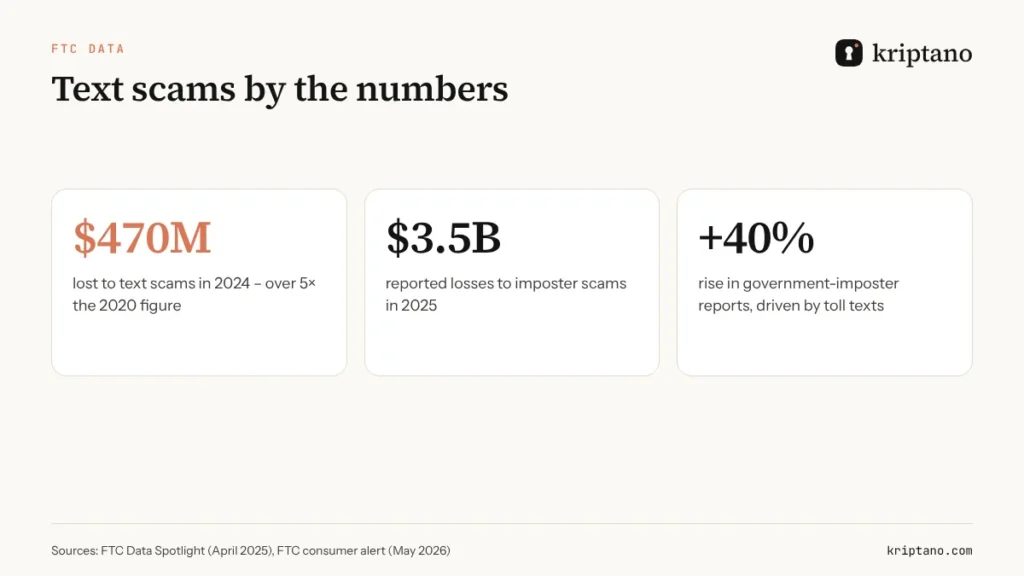
In its Data Spotlight on text scams, the Federal Trade Commission reported that people lost $470 million to text scams in 2024 – more than five times the 2020 figure, even though the number of reports fell. Since most fraud is never reported, the real number is far higher. The most reported types were fake package deliveries, fake bank “fraud alerts”, unpaid tolls, job “task” scams and “wrong number” messages that turn into investment schemes.
In 2025 imposter scams were the top fraud category for the ninth year running, with reported losses up nearly 20% to $3.5 billion – and the FTC said toll texts drove a 40% rise in reports of government impersonation.
How the toll scam text works
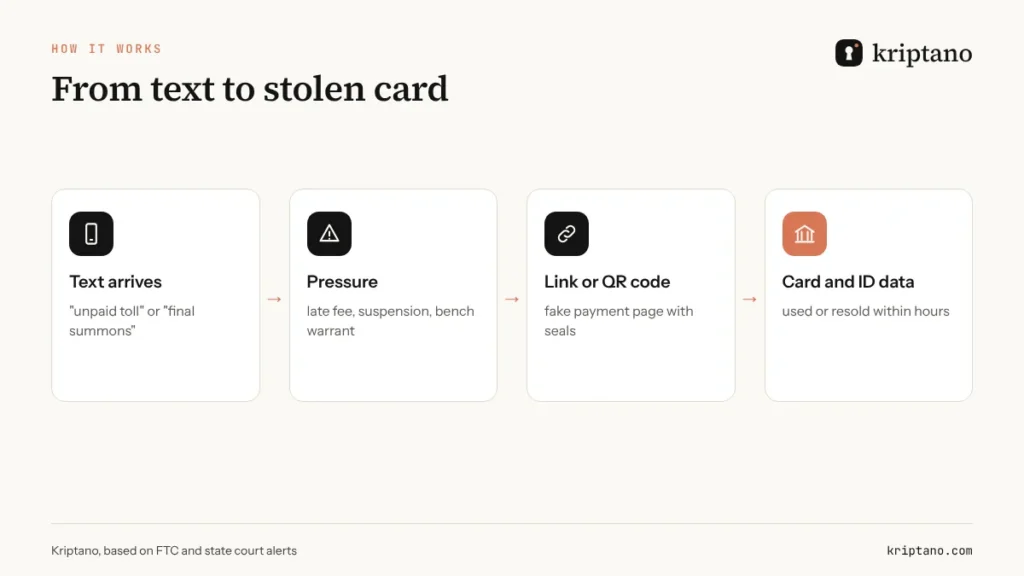
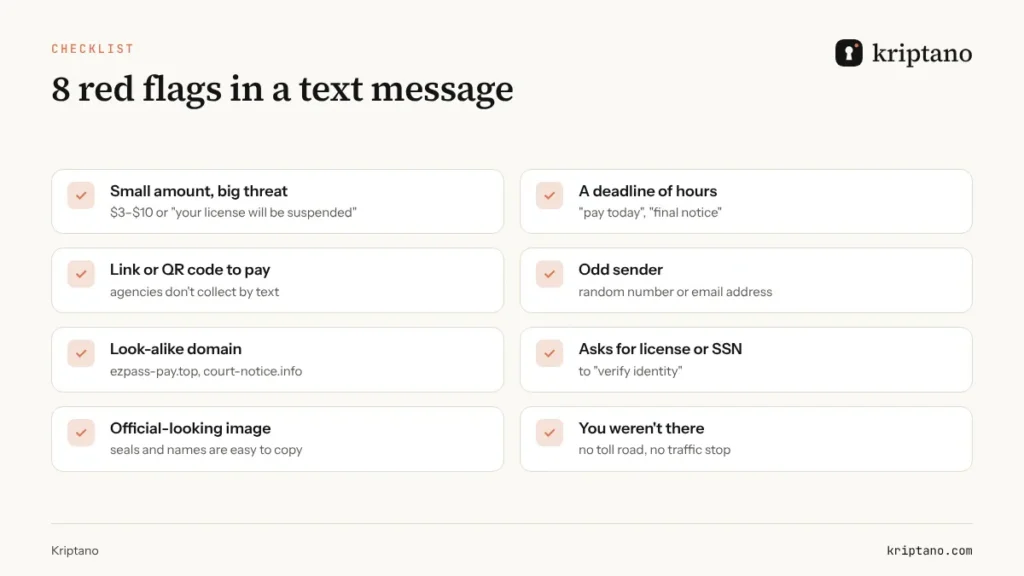
The message claims you owe a small toll – a few dollars – and threatens late fees, a suspended registration or even your license if you don’t pay immediately. It may spoof real programs such as E-ZPass, SunPass, FasTrak or TxTag. The link leads to a convincing payment page that asks for your card number, billing address and sometimes your driver’s license number.
The small amount is the point. Few people would wire $2,000 to a stranger, but almost anyone will pay $6.99 to make a problem go away. The real prize is your card details and personal data, which are used for larger charges or sold on.
The traffic court summons scam
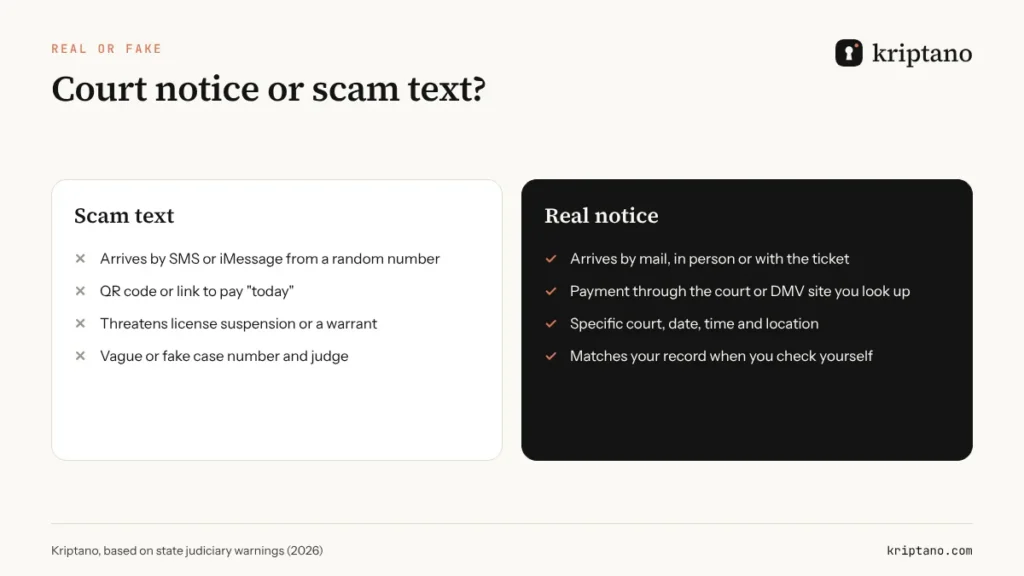
In 2026 the toll scam evolved. Courts and attorneys general from California to Connecticut have warned about texts that look like a court summons for an unpaid traffic violation, often as an image with a state seal, a judge and a clerk, a case number in a format like “TR-2026” and a QR code. In April 2026 the FTC said it had seen a spike in reports of exactly this scam. Some recipients were alarmed enough to show up at courthouses for hearings that didn’t exist.
Courts are clear about one thing: they don’t summon people or collect fines by text. Real notices arrive by mail, in person or through a ticket handed to you at a traffic stop. A text demanding payment through a link or QR code is not a court order.
8 red flags of scam texts
What to do if you get one
Don’t reply, don’t tap the link and don’t scan the code. If you think you might really owe something, look up the toll agency or court yourself and check your account there. Then report and delete:
- Forward the text to 7726 (SPAM) so your carrier can block the sender.
- Report it at ReportFraud.ftc.gov; for court-themed texts your state judiciary or attorney general may also take reports.
- Delete the message and block the number.
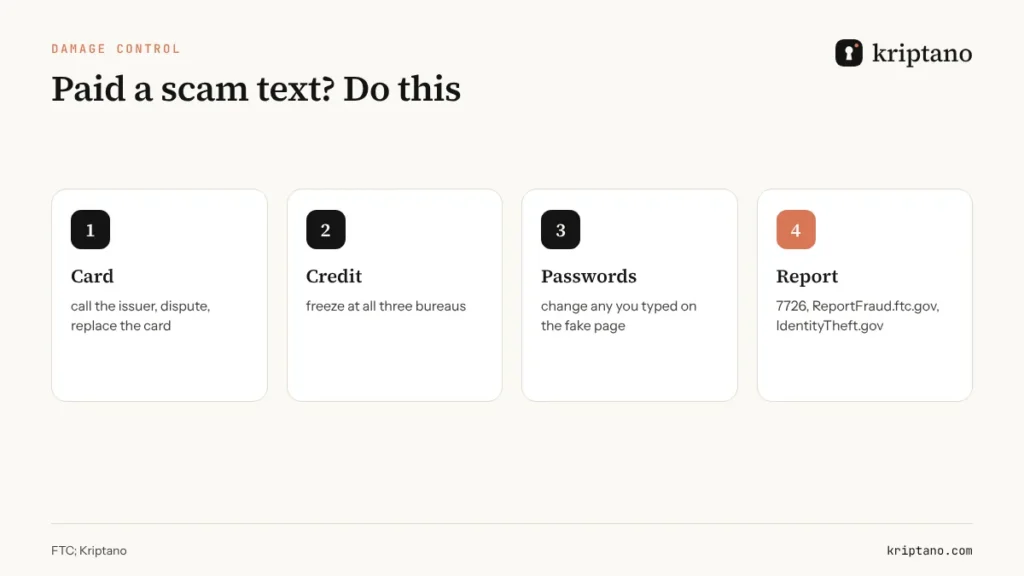
Already paid or typed in your details?
Call your card issuer
Use the number on the back of the card, dispute the charge and ask for a new card.
Watch your accounts
Turn on transaction alerts and check statements for small test charges.
Freeze your credit
Free at Equifax, Experian and TransUnion if you shared your SSN or license number.
Change reused passwords
If the fake page asked you to log in anywhere.
Report identity theft
At IdentityTheft.gov for a recovery plan.
More on the next steps in our guide to what to do after a data breach. If the text led you to a login page, the advice in how to check if a link is safe applies too.
The rule that beats every scam text
Every one of these scams asks you to act on information that arrived through the message itself. The fix is the same each time: use a channel you already trust – the number on your card, the website you type in, the account you already have. The same logic applies at work. If a “vendor” texts new bank details or a “manager” asks for a password, verify by calling a number you already know. And when you genuinely need to send a password or ID to someone, don’t paste it into a text: use a one-time secret link that deletes itself after reading – see how to send a Social Security number securely.
Frequently asked questions
Are unpaid toll texts real?
Almost never. Toll agencies may send texts to customers who signed up for alerts, but a text demanding immediate payment through a link is a classic scam. Check your balance by logging in to the toll agency’s site yourself.
Do courts send traffic summons by text?
No. Real court notices arrive by mail, in person or through a citation handed to you. A text with a QR code to pay a traffic fine is a scam.
What happens if I click a scam text link?
Usually nothing until you enter information. If you typed in card details, call your card issuer right away; if you shared your SSN or license number, freeze your credit.
How do I report scam texts?
Forward them to 7726 (SPAM), report them at ReportFraud.ftc.gov and delete them. You can also report court-themed texts to your state judiciary or attorney general.
Why are the amounts so small?
Small amounts lower your guard. The real goal is your card number and personal details, which are used for bigger fraud later.
Can I get my money back?
Often, if you act quickly. Card issuers can dispute fresh charges; payments by wire, crypto or gift card are much harder to recover.
Sensitive details don't belong in texts
Send passwords, IDs and account numbers with a one-time link – encrypted in your browser and deleted after reading.