Self-Destructing Chat: How a Secure Chat Room With No App Works
How a self-destructing chat works in the browser, why your guest picks a two-digit number on top of the link, and when a room that destroys itself beats WhatsApp, Slack or email for confidential conversations.
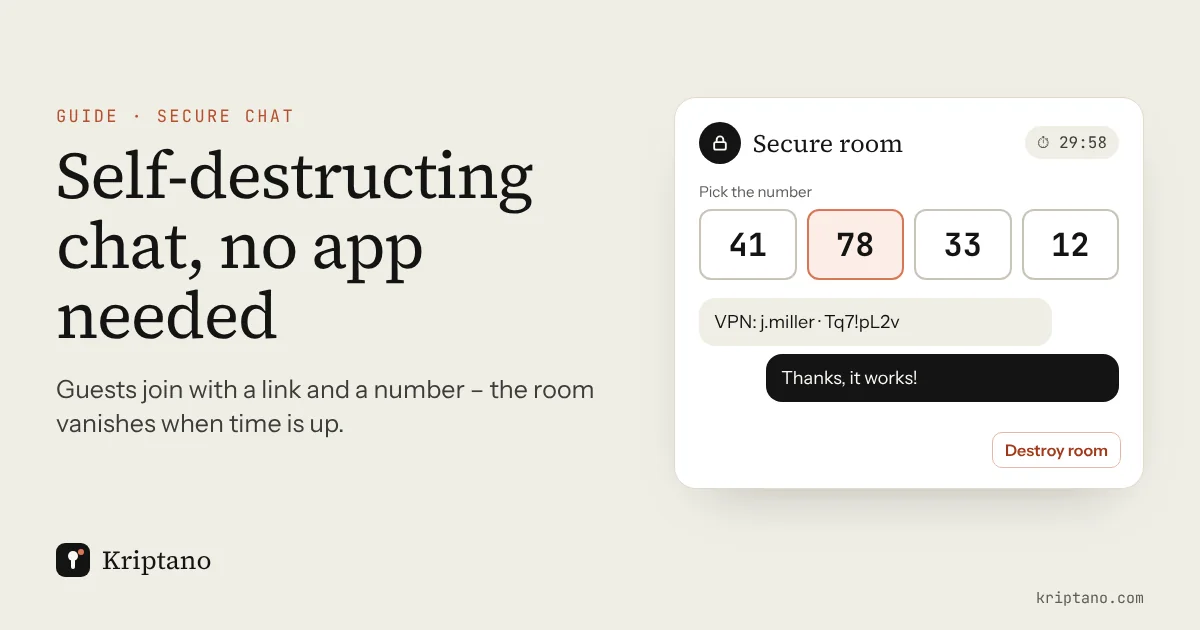
Sometimes you need a self-destructing chat for exactly one conversation: reading login details to a client, checking payroll with your accountant or handling a security incident with a colleague – without leaving it all in WhatsApp, Slack or an inbox for years. A Kriptano room is a self-destructing chat in the browser that your guest opens without an app or account, and that destroys itself when the time you chose runs out.
This guide explains how such an encrypted chat room works step by step, why your guest has to pick a two-digit number on top of the link, how it differs from disappearing messages in popular apps, and what even the best secure chat without an app can’t prevent.
Contents
- Why a regular chat isn't enough for confidential conversations
- How a self-destructing chat works in a Kriptano room
- Number matching: protection against intercepted links
- Self-destructing chat vs WhatsApp, Slack and email
- How long a room lasts and how many people can join
- When to use a self-destructing chat
- What a self-destructing chat can't prevent
- Checklist before a confidential conversation
- Self-destructing chat FAQ
Why a regular chat isn’t enough for confidential conversations
WhatsApp, Signal and iMessage encrypt messages from device to device, and that’s good. The problem starts after the conversation: the message stays in the history on both phones, in backups, on linked computers and in groups that someone adds a new member to later. The password you sent a client two years ago is still there today – nobody just remembers where.
- History stays – a chat exists until someone deletes it manually, and usually nobody does.
- You need a phone number – WhatsApp means swapping personal numbers, even with people you’ll meet once.
- Copies spread – backups, forwards and screenshots live outside your control.
- Your guest needs the app – a client who doesn’t use WhatsApp, or can’t for work, ends up back on email.
For personal data it’s a compliance question too. Article 5 of the GDPR (and the UK GDPR) requires that data is kept no longer than necessary. A self-destructing chat applies that principle automatically: when the room expires, messages disappear from the server and from every participant’s screen.
256-bit
random room key, created in your browser
4 numbers
the guest picks the right one, or entries stop
15 min – 7 days
you choose how long the room lasts
How a self-destructing chat works in a Kriptano room
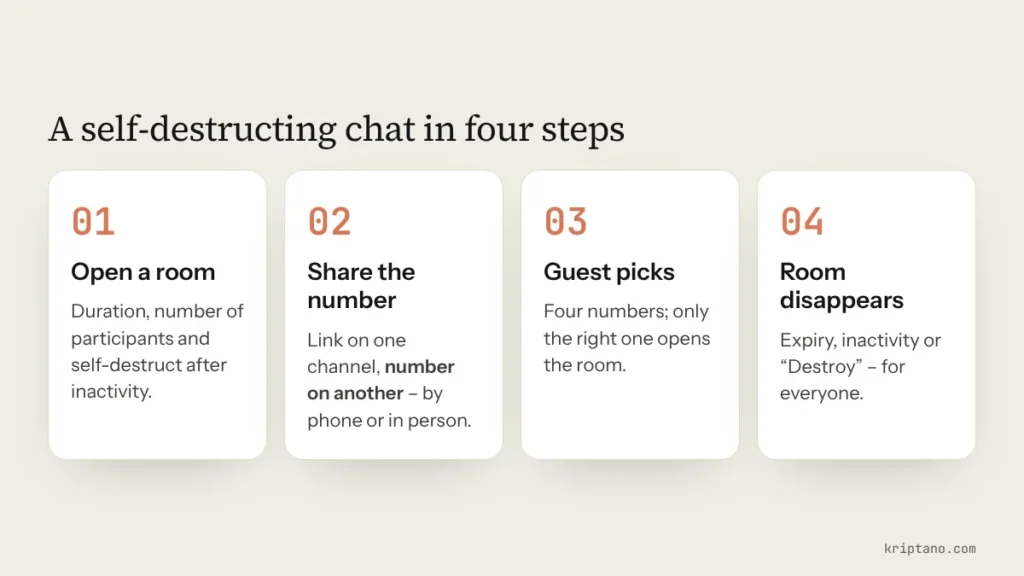
A signed-in user opens the room on the Secure Chat page. The guest needs nothing but the link and the number. The whole flow takes four steps:
Open a room
Choose how long it lasts (15 minutes to 7 days, depending on your plan), how many people may join and after how many minutes without messages it self-destructs.
Share the number on another channel
A two-digit number appears on your screen. Send the link by email or text, and read the number out by phone or in person.
The guest picks the number
Your guest opens the link in a browser and chooses from four numbers. The right one lets them in; a one-to-one room then locks itself.
The room disappears
When time runs out, nobody writes, or anyone clicks “Destroy”, encrypted messages, participants and files are deleted.
Under the hood, the room key is created in your browser and travels only in the part of the link after the #. Browsers never send that part of the address to the server, so Kriptano relays – and, until the room ends, stores – nothing but ciphertext. Messages are encrypted with AES-256-GCM using a key derived from the room key, and participant names are encrypted with it too. Once a guest is in, the key stays only in their browser until the room ends and is removed from the address bar, so reloading the page doesn’t ask for the number again.
Number matching: protection against intercepted links
A link can be forwarded, intercepted or sent to the wrong inbox. That’s why a self-destructing chat in Kriptano asks for a second proof: a number only the host can see. Microsoft has used the same idea since May 2023 for sign-in approvals in Microsoft Authenticator (number matching) – typing the number shown on screen makes accidental or pressured approvals much harder.
In a room it works like this:
- the guest sees four two-digit numbers, and only one is right;
- after a wrong pick, entries stop for everyone until the host allows another try or generates a new number;
- after three mistakes the room is destroyed, so guessing doesn’t pay;
- the host sees the failed attempt in the room immediately.
Tip
Never send the link and the number in the same message. If the link goes by email, say the number on the phone – an attacker would then have to intercept both channels.
Open a self-destructing chat
Rooms are opened by signed-in users (a free account is enough). Guests join without an account – just the link and the number you tell them.
Free plan – rooms per month: 2, each up to 30 minutes. Sign in with an email code, Google or Microsoft.
Your open rooms
Self-destructing chat vs WhatsApp, Slack and email
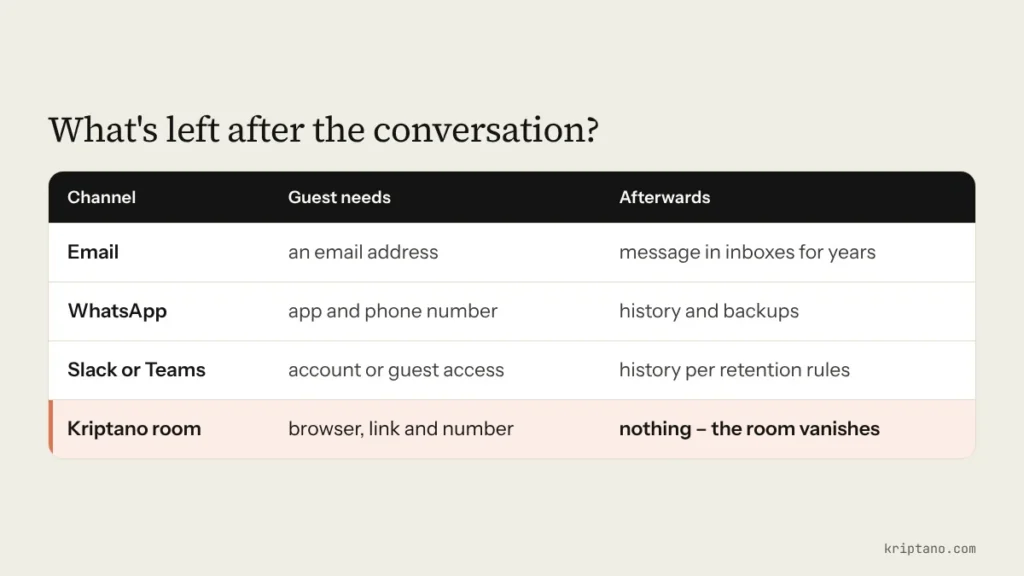
Every major messenger encrypts messages today, but they differ in what’s left after the conversation and what the other person needs.
| Channel | What the guest needs | What’s left afterwards | Who can read the content |
|---|---|---|---|
| An email address | The message in both inboxes, for years | Email providers, unless end-to-end encrypted | |
| The app and a phone number | History and backups, unless disappearing messages are on | Only participants (end-to-end) | |
| Slack or Teams | An account in your workspace or guest access | History under your organization’s retention rules | Your organization; chats aren’t end-to-end encrypted |
| Kriptano room | Just a browser, the link and the number | Nothing – the room is deleted for everyone | Only participants (key in the link) |
Disappearing messages in WhatsApp or Signal are a step in the right direction, but both sides still need the app and an account tied to a phone number. If that’s the sticking point, see WhatsApp alternatives without a phone number.
How long a room lasts and how many people can join
You open a self-destructing chat within the limits of your plan. Guests never need an account; rooms, participants and maximum duration look like this:
| Plan | Rooms per month | Participants | Longest duration | Files in room |
|---|---|---|---|---|
| Free | 2 | 2 | 30 minutes | Text only |
| Start | 15 | 2 | 2 hours | Up to 50 MB |
| Pro | Unlimited | 10 | 24 hours | Up to 500 MB |
| Pro Plus | Unlimited | 50 | 7 days | Up to 10 GB |
On every plan a room can be destroyed early – after 10, 30, 60 or 120 minutes without messages, or with one click. Pro and Pro Plus add a room log without message content, opening rooms via the API and your logo in the room. Current prices and all differences are on the pricing page.
When to use a self-destructing chat
Handing over credentials to a client
New website, VPN, server or app account: your client needs a username, a password and a two-factor code – and you want to check right away that everything works. A self-destructing chat set to 30 minutes lets you do it live, with no trail in anyone’s inbox. For a one-off handover without a conversation, a one-time secret link is enough; the full process is in our guide to temporary passwords and login credentials.
Accounting, legal advice and HR
Salaries, tax IDs, sick leave and contracts don’t belong in a group chat. A short self-destructing chat with a client or employee ends when the conversation ends, and on plans with files you can share a document right in the room.
IT support and security incidents
When email is compromised, your team needs a fallback channel the attacker can’t see. A self-destructing chat for up to 50 participants, open for a few hours, works as a temporary war room. For what GDPR and NIS2 expect, read NIS2 compliance and GDPR.
Healthcare and other sensitive conversations
Doctors, therapists and lawyers sometimes need to exchange a few sensitive sentences outside the office. A secure chat without an app doesn’t ask the other person to install anything or reveal their phone number.
What a self-destructing chat can’t prevent
No self-destructing chat protects against everything, and it’s worth knowing that up front:
- screenshots and photos of the screen – the other person can always write down or capture what they see;
- an infected device – malware on a computer or phone sees messages before they’re encrypted;
- the wrong person – if you give the number to the wrong person, they’ll get in; only share it with someone you know;
- record-keeping duties – if your industry must retain business communications (US regulators have fined financial firms over off-channel messaging), a room that disappears is not the place for those conversations.
Important
A self-destructing chat protects your clients’ confidential data – it is not meant for hiding communications from authorities or for avoiding record-keeping obligations.
Checklist before a confidential conversation
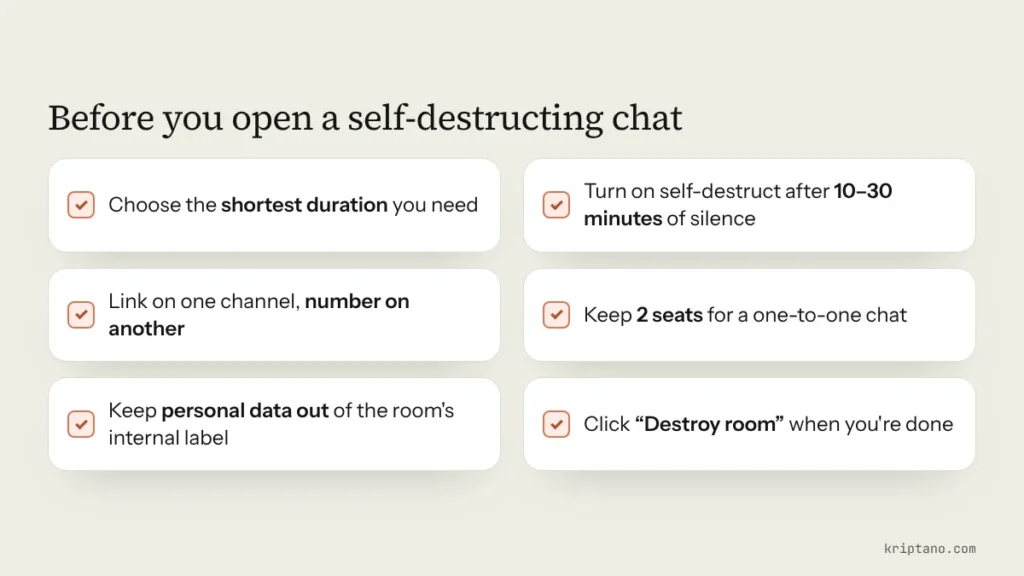
- Choose the shortest duration you actually need – 15 to 30 minutes is plenty for a password handover.
- Turn on self-destruct after inactivity, so the room disappears even if the conversation stops halfway.
- Send the link on one channel and the number on another.
- Keep two seats for a conversation with one client – the room locks as soon as the guest joins.
- The internal label is visible only to you but isn’t encrypted, so keep names and IDs out of it.
- When you’re done, click “Destroy room” instead of waiting for it to expire.
Self-destructing chat FAQ
Is the self-destructing chat free?
Yes. A free account opens rooms for two participants lasting up to 30 minutes. Paid plans add longer rooms, more participants and files, and guests never need an account.
Does my guest need an app or a phone number?
No. The self-destructing chat runs in any modern browser on a computer or phone. Your guest only needs the link and the number you give them.
What if someone intercepts the link?
Without the number they can’t get in. A wrong pick stops entries and alerts the host, and after three mistakes the room is destroyed.
Can I share files in a room?
On paid plans, yes – files are encrypted in the browser and deleted together with the room. On the free plan, rooms are text only.
Does Kriptano keep a record of the conversation?
No. When the room closes, encrypted messages, participant tokens and files are deleted. All that remains is a record that the room existed, with no content, for 30 days.
Open a self-destructing chat for your next confidential conversation
Free with an account – guests join without signing up or installing anything.