NIS2 and GDPR Compliance: How to Share Credentials and Sensitive Data the Right Way
What NIS2 and GDPR actually require for exchanging passwords and confidential documents, who is affected, what the fines are, and a 7-point internal procedure you can adopt today.
Contents
Two European laws now shape how organisations exchange passwords and confidential documents: the General Data Protection Regulation (GDPR), in force since 2018, and the NIS2 Directive, which most EU member states have now turned into national law. Neither tells you which tool to use. Both expect you to protect data with appropriate technical measures – and to be able to prove it. This guide explains what that means in practice for NIS2 compliance and GDPR when your team sends credentials and documents, and gives you a procedure you can adopt immediately.
This is general information, not legal advice. For the practical side of sending credentials, see how to share passwords securely.
NIS2 compliance in brief
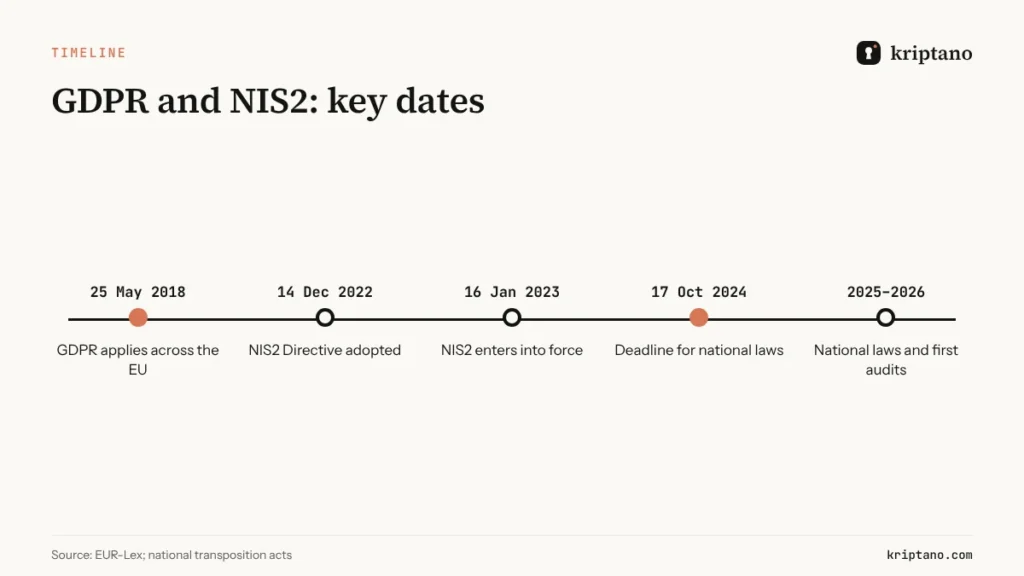
The NIS2 Directive (EU) 2022/2555 replaced the original NIS Directive and greatly expanded its scope. It applies to medium-sized and large organisations in 18 sectors – including energy, transport, banking, health, digital infrastructure, managed IT services, public administration, manufacturing, food and waste – classified as essential or important entities. Member states had to transpose it by 17 October 2024; many were late, but by 2026 the large majority had national laws in place, and Germany’s NIS2 implementation act has been in force since December 2025.
What NIS2 compliance requires (Article 21)
- policies on cryptography and, where appropriate, encryption;
- access control and asset management;
- multi-factor authentication and secured communications;
- supply chain security, including the security practices of your suppliers;
- incident handling and policies to assess the effectiveness of these measures.
Article 20 adds management accountability: management bodies must approve the measures, oversee them and complete training – cybersecurity is no longer just an IT topic.
Not covered? NIS2 compliance can still reach you
What GDPR compliance adds
The GDPR applies to any organisation processing personal data of people in the EU – regardless of size or sector, and including companies outside the EU that serve EU customers. Three principles are directly relevant:
- Data minimisation and storage limitation (Article 5): personal data must not be kept longer than necessary. A password or ID scan sitting in ten inboxes for years fails this test.
- Security of processing (Article 32): appropriate measures, explicitly including encryption.
- Breach notification (Articles 33–34): if a mailbox containing personal data is compromised, you may have to notify the authority within 72 hours. Data that is encrypted and no longer stored reduces both the risk and the reporting burden.
Fines and accountability
Both regimes allow substantial fines, and the higher of the fixed amount and the percentage of worldwide turnover applies.
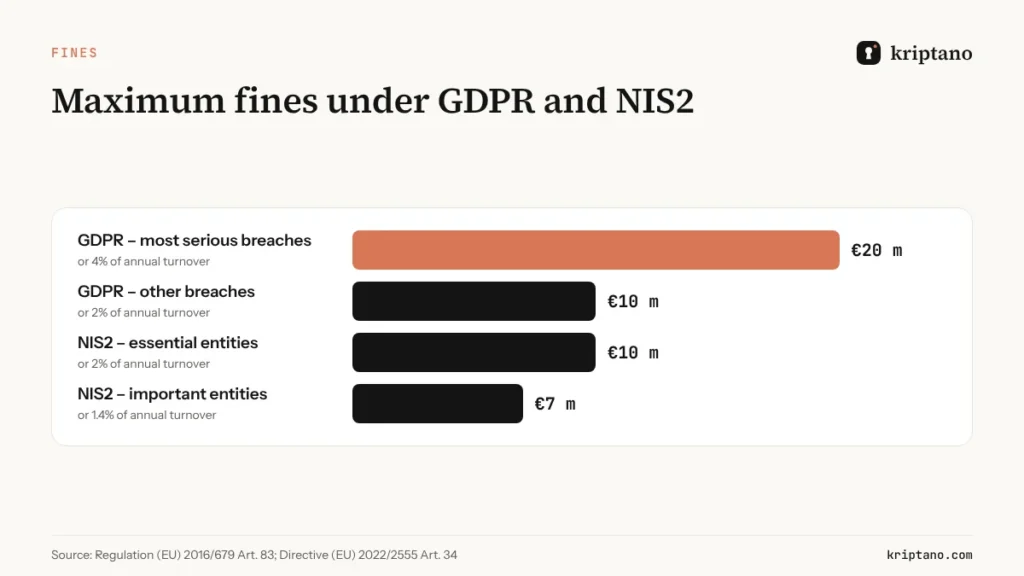
Fines are not the only consequence of weak NIS2 compliance. Under NIS2 management can be held personally responsible, and every incident costs time, customer trust and – for suppliers – contracts.
NIS2 compliance and GDPR compliance for data exchange: practical controls
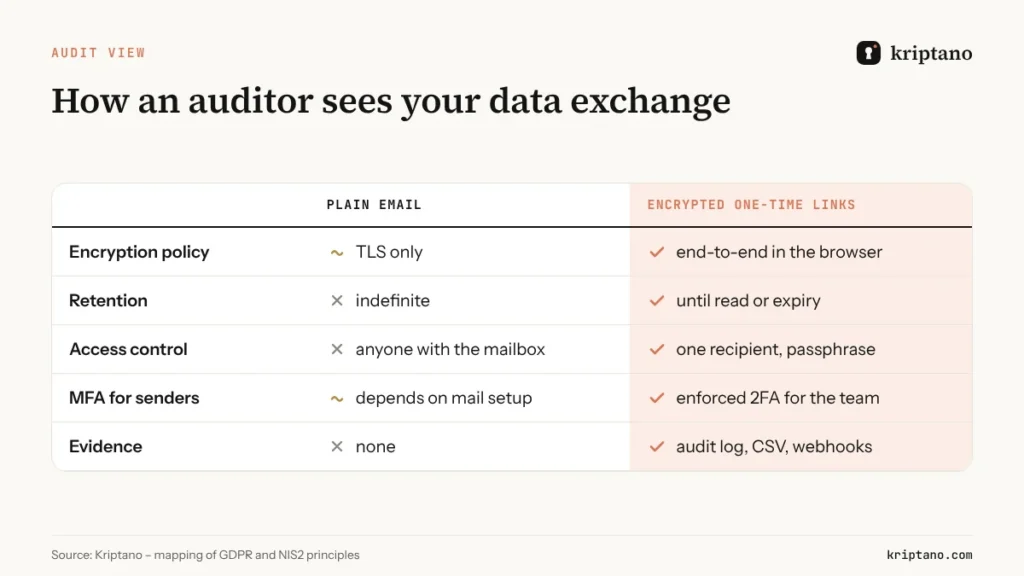
The table below translates legal requirements into concrete controls for everyday data exchange.
| Requirement | Source | Practical control |
|---|---|---|
| Encryption of personal data | GDPR Art. 32, NIS2 Art. 21 | encryption in the sender’s browser (AES-256-GCM) |
| Storage limitation | GDPR Art. 5 | secrets deleted after reading or expiry |
| Access control and MFA | NIS2 Art. 21 | team roles, enforced two-factor login, SSO |
| Supply chain security | NIS2 Art. 21 | secret requests for suppliers and clients |
| Evidence and effectiveness | GDPR Art. 5(2), NIS2 Art. 21 | audit log with CSV export, webhooks to SIEM |
| Data location | GDPR Chapter V | servers and storage in the EU |
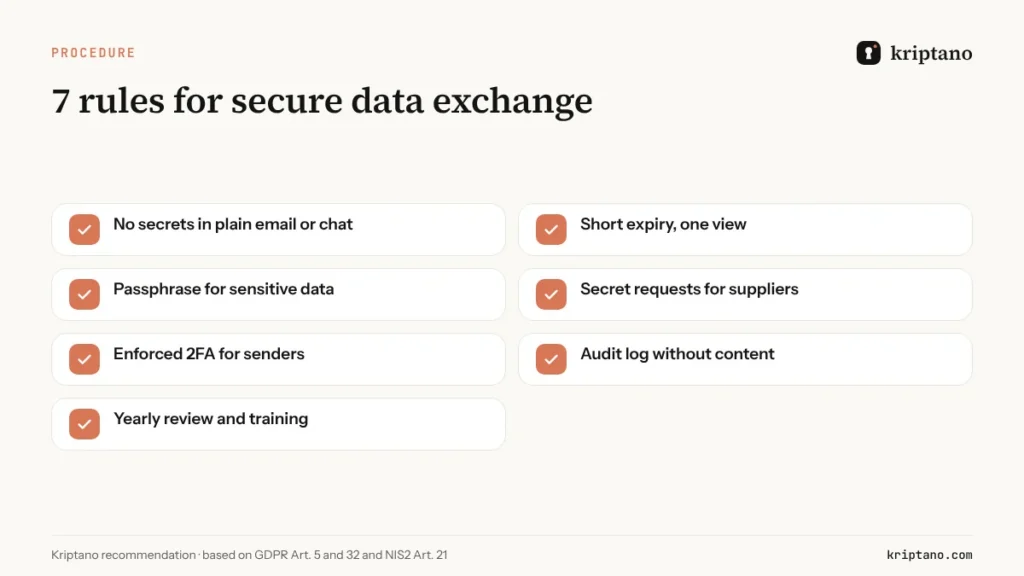
A 7-point procedure for NIS2 compliance in data exchange
Most auditors want to see a written rule that people actually follow. This procedure is short enough to be used:
- No credentials or confidential documents in plain email, chat or SMS. Use encrypted one-time links.
- Shortest practical expiry and one view by default.
- Passphrases for sensitive data, shared through a second channel.
- Credentials and documents from clients and suppliers are requested with a secret request, not by email.
- Everyone who sends secrets uses two-factor login; team administrators enforce it for all members.
- Every exchange is logged – who, when, opened or not – without content; logs are reviewed and exported for audits.
- The procedure is reviewed yearly and new employees are trained during onboarding.
How Kriptano supports NIS2 compliance and GDPR evidence
– Encryption before upload: AES-256-GCM in the browser; the key never reaches the server (security details). – Minimal retention: secrets and files are deleted after reading or expiry; only metadata stays for your history. – Team controls: roles (owner, administrator, member), enforced 2FA for the whole team, sign-in with Google or Microsoft. – Audit log: who sent what and when it was opened, filterable and exportable as CSV, also via the API. – Webhooks: real-time events (secret created, opened, expired) to your SIEM or ticketing system, signed with HMAC. – EU hosting and no third-party analytics on secret pages.
For the full background on encrypted files, see sending sensitive documents securely; for partners that insist on encrypted email, see sending encrypted email.
Free
For the occasional password, no sign-up.
$0€0
forever
Try for free- 8 secrets per month per IP address
- Lifetime up to 7 days
- 1 view per link
- Encrypted attachments up to 5 MB
- Extra passphrase to open
- QR code for the link
- Password generator + generator API
- SSO login: Google + Microsoft
Start
For freelancers and small offices.
$6€6 $4.80€4.80 / mo
billed monthly billed yearly: $57.60€57.60
Choose Start- 2,000 secrets per month
- Lifetime up to 30 days
- Up to 10 views per link
- Encrypted attachments up to 50 MB
- 2 GB attachment storage
- Email notification when a secret is opened
- Password generator + generator API
- SSO login: Google + Microsoft
- Two-factor login (authenticator app)
- Up to 10 secret requests (clients send data to you)
Most popular
Pro
For agencies, IT and accounting teams.
$24.90€24.90 $19.90€19.90 / mo
billed monthly billed yearly: $238.80€238.80
Choose Pro- 30,000 secrets per month
- Lifetime up to 90 days
- Up to 50 views per link
- Encrypted attachments up to 500 MB
- 20 GB attachment storage
- Email notification when a secret is opened
- Password generator + generator API
- SSO login: Google + Microsoft
- Two-factor login (authenticator app)
- Up to 1,000 secret requests (clients send data to you)
- Automatic delivery of secrets and requests by email
- API access and integrations
- Your logo and colors
- Team of up to 5 members
- Audit log with CSV export
- Webhooks (up to 10) with HMAC signatures
- Team roles and enforced 2FA
Pro Plus
Your domain, your brand and larger teams.
$62.90€62.90 $49.90€49.90 / mo
billed monthly billed yearly: $598.80€598.80
Choose Pro Plus- Unlimited secrets
- Lifetime up to 365 days
- Up to 100 views per link
- Encrypted attachments up to 10 GB
- 1,000 GB attachment storage
- Email notification when a secret is opened
- Password generator + generator API
- SSO login: Google + Microsoft
- Two-factor login (authenticator app)
- Unlimited secret requests
- Automatic delivery of secrets and requests by email
- API access and integrations
- Your logo and colors
- Team of up to 50 members
- Audit log with CSV export
- Unlimited webhooks with HMAC signatures
- Team roles and enforced 2FA
- Unlimited custom domains (e.g. secrets.your-company.com)
- Send email from your own domain
- Your own SMTP server
- Geo-blocking and IP allowlist
- No Kriptano branding (white label)
All prices include VAT or sales tax. Bank transfer offers are at the same final price. Subscription by card, PayPal, Apple Pay or Google Pay via Paddle – or bank transfer against an offer. Cancel anytime.
Frequently asked questions
Does NIS2 compliance apply to my company?
NIS2 covers medium-sized and large organisations in 18 sectors, plus some entities regardless of size. Check your national implementation law. Even if you are not covered, customers who are may require you to meet similar standards as part of their supply chain.
Does GDPR require encryption?
GDPR requires appropriate security measures and explicitly names encryption as an example (Article 32). For passwords and confidential documents, encryption is the most practical way to meet that requirement.
Is sending passwords by email a GDPR violation?
Not automatically, but it conflicts with storage limitation and makes a breach much more likely and harder to contain. Regulators judge whether your measures were appropriate for the risk.
What evidence do auditors ask for?
Usually a written procedure, proof that it is applied (logs, exports), access control including MFA, and evidence of training and regular review.
Can I export the audit log for an audit?
Yes. In Pro and Pro Plus the audit log can be filtered by period and event type and exported as CSV, or read via the API.
Where is the data stored?
Kriptano’s servers and file storage are in the European Union. Secret content is encrypted in the browser and never readable on the server.
Make secure data exchange part of your policy
Start free; add team roles, enforced 2FA and an audit log when you need them.