End-to-End Encryption Explained: How E2EE Works, Where It Stops, and How to Check It
End to end encryption is on by default in WhatsApp, Signal, iMessage and – since 2026 – most iPhone-to-Android texts. How E2EE and asymmetric encryption work in plain English, the five places it stops protecting you, and a checklist to tell real E2EE from marketing.
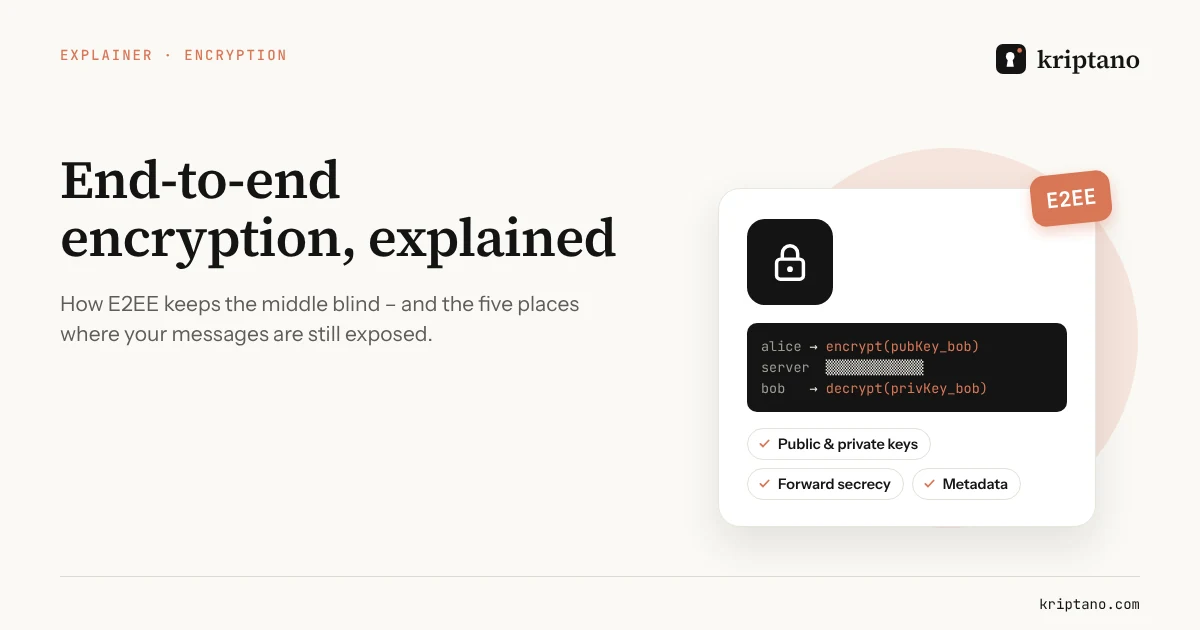
“End-to-end encrypted” appears on every messaging app, cloud drive and video tool, and roughly five thousand people a month search for what end to end encryption actually means. The short version: only the sender and the recipient hold the keys, so nobody in between – not the internet provider, not a hacker on the café Wi-Fi, not even the company running the service – can read the content. The longer version is more interesting, because E2EE has clear limits, and knowing them is what keeps your data safe.
This explainer covers how E2EE works (including asymmetric encryption in plain English), where it is switched on by default in 2026, the five places it stops protecting you, and a checklist for telling real end to end encryption from marketing.
Contents
- What end to end encryption means
- How E2EE works: asymmetric encryption in plain English
- Where E2EE is on by default in 2026
- Five places where end to end encryption stops
- E2EE for secrets and files: how Kriptano does it
- How to check whether something is really E2EE
- Four myths about end to end encryption
- A practical end to end encryption setup for a small team
- E2EE and email
- What E2EE means for businesses
- Frequently asked questions
What end to end encryption means
Think of three kinds of protection for the same message:
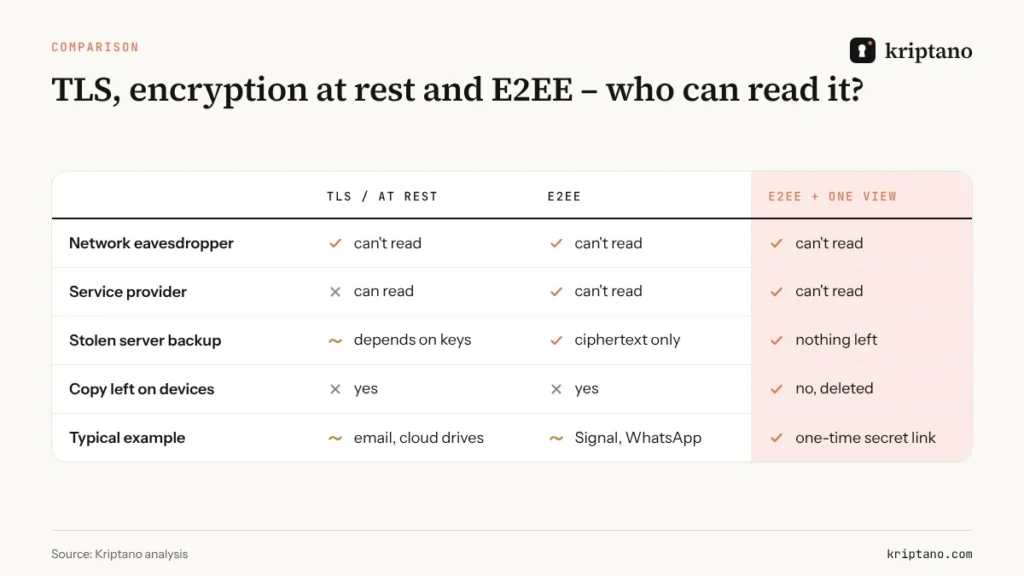
- Encryption in transit (TLS) protects the message while it travels between your device and a server, and between servers. The server itself sees the plain text. This is the padlock in your browser and the default for email.
- Encryption at rest protects stored data on the provider’s disks. The provider holds the keys and can decrypt when it needs to.
- End to end encryption (E2EE) encrypts the message on the sender’s device and decrypts it only on the recipient’s device. The provider relays and stores ciphertext it can’t read.
The difference matters most on the day something goes wrong: a breach at the provider, a rogue employee, a subpoena, or a government order. With E2EE, the provider has nothing readable to hand over.
How E2EE works: asymmetric encryption in plain English
Most systems built this way combine two kinds of cryptography.
Asymmetric encryption uses a key pair. Your public key can be shared with anyone – it works like an open padlock that people can snap shut on a box addressed to you. Your private key stays on your device and is the only thing that opens that padlock. Anyone can encrypt for you; only you can decrypt.
Symmetric encryption uses one shared key to lock and unlock. It is much faster, so it does the heavy lifting: in practice, asymmetric encryption is used to agree on a fresh symmetric key, and that key – typically AES – encrypts the actual message or file.
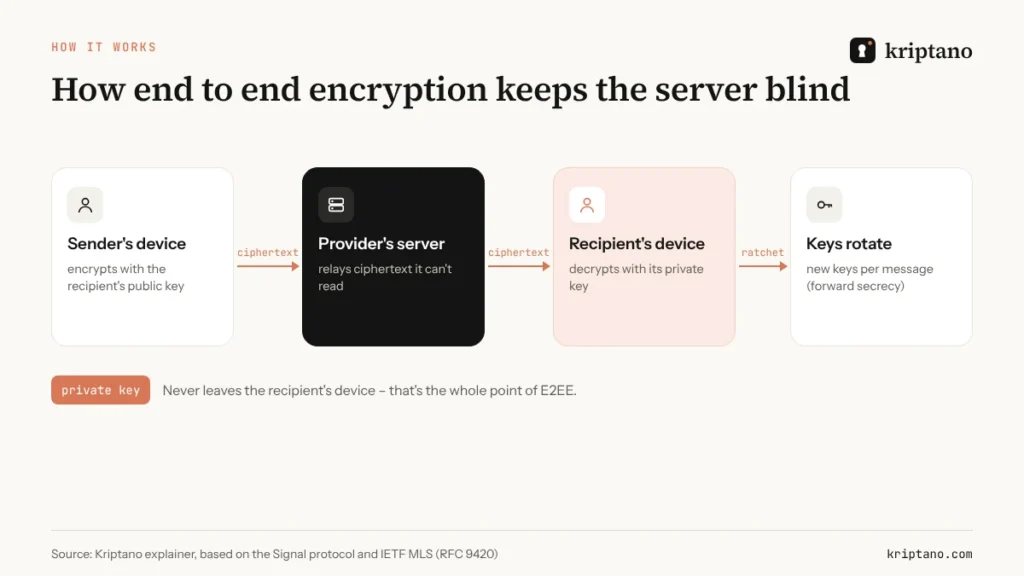
Modern messengers add two refinements. Forward secrecy means keys change constantly – the Signal protocol “ratchets” to new keys with every message – so stealing today’s key doesn’t unlock last year’s chats. And for large groups, the IETF’s Messaging Layer Security standard (MLS, RFC 9420) lets thousands of devices share keys efficiently; it is the protocol behind encrypted RCS texting.
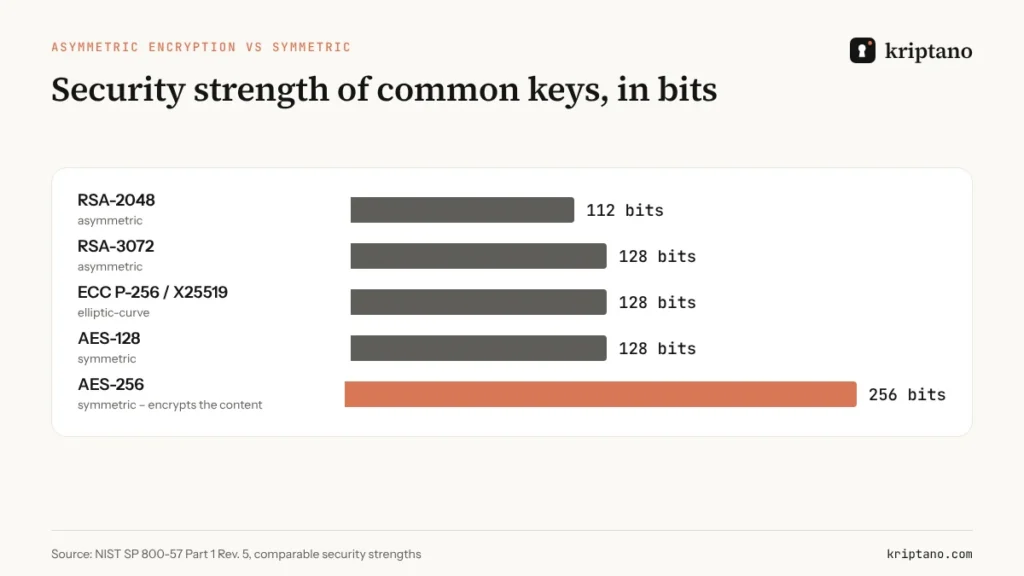
How strong are the keys? NIST’s key-management guidance (SP 800-57) compares them by “security strength”. A 3072-bit RSA key or a 256-bit elliptic-curve key both offer about 128 bits of strength – far beyond any practical attack today – while AES-256 offers 256 bits for the content itself.
Where E2EE is on by default in 2026
It went from niche to normal in a decade:
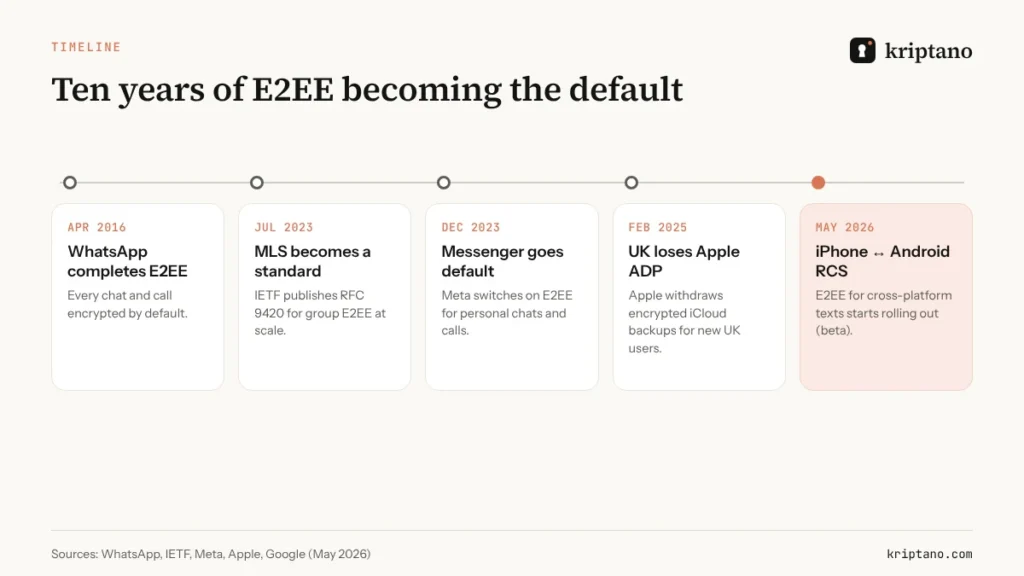
- WhatsApp finished rolling out end to end encryption for all chats and calls in April 2016.
- Signal, iMessage and FaceTime have been end-to-end encrypted from the start.
- Facebook Messenger made E2EE the default for personal chats in December 2023.
- iPhone-to-Android texting got E2EE in May 2026: with iOS 26.5 and the latest Google Messages, encrypted RCS began rolling out in beta, on by default but dependent on carrier support, as Google announced.
Plain SMS still has no encryption at all – which is why US agencies urged people to switch to encrypted apps after the Salt Typhoon telecom hacks. Our encrypted text message guide covers that story.
Five places where end to end encryption stops
E2EE protects data between devices. It says nothing about what happens on the devices, in backups or in the metadata around the message.
1. The devices themselves
If a phone is infected with spyware, unlocked on a table, or simply screenshotted, the message is readable – it has to be decrypted to be shown. E2EE protects the pipe, not the endpoints.
2. Backups
A chat can be end-to-end encrypted while its cloud backup is not. WhatsApp offers end-to-end encrypted backups, but you have to switch them on. Apple encrypts iCloud backups end to end only with Advanced Data Protection (ADP) – and in February 2025 Apple stopped offering ADP to new users in the UK after a reported government order under the Investigatory Powers Act, as MacRumors explained. Reports in 2025 and 2026 describe a narrower follow-up notice and a legal challenge, but for UK users the practical point stands: check what your backups do.
3. Metadata
Who talked to whom, when, how often and from where is usually visible to the provider, because the system needs it to deliver messages. Metadata alone can reveal a lot – a late-night call to a lawyer or a doctor tells a story without a single word of content.
4. The other person
E2EE delivers the message faithfully to the recipient – who can then forward it, screenshot it or lose their phone. Group chats add every member’s device to that list.
5. Time
Encryption is not deletion. An end-to-end encrypted message containing a password is just as dangerous in two years if either device or backup is compromised. That’s where one-view, self-destructing delivery adds something E2EE alone doesn’t.
E2EE for secrets and files: how Kriptano does it
Messengers solve conversations. Sending a single secret – a password, a recovery code, a contract – has a different shape: one sender, one recipient, one moment. Kriptano applies the same principles to that moment:
- your browser encrypts the secret with AES-256-GCM before anything is uploaded;
- the decryption key lives only in the link fragment after
#, which browsers never send to the server; - the server stores ciphertext, and deletes it after the first view or at expiry;
- for secret requests, where a client sends *you* a password, the form uses asymmetric encryption (RSA-OAEP): it encrypts with a public key from your request, and only your private link can decrypt.
The result is end to end encryption with an expiry date: nobody in the middle can read the secret, and afterwards there’s nothing left to read. More detail is in our guide to one-time secret links.
How to check whether something is really E2EE
“Encrypted” on a product page is not proof. These questions separate real E2EE from encryption that only covers part of the journey:
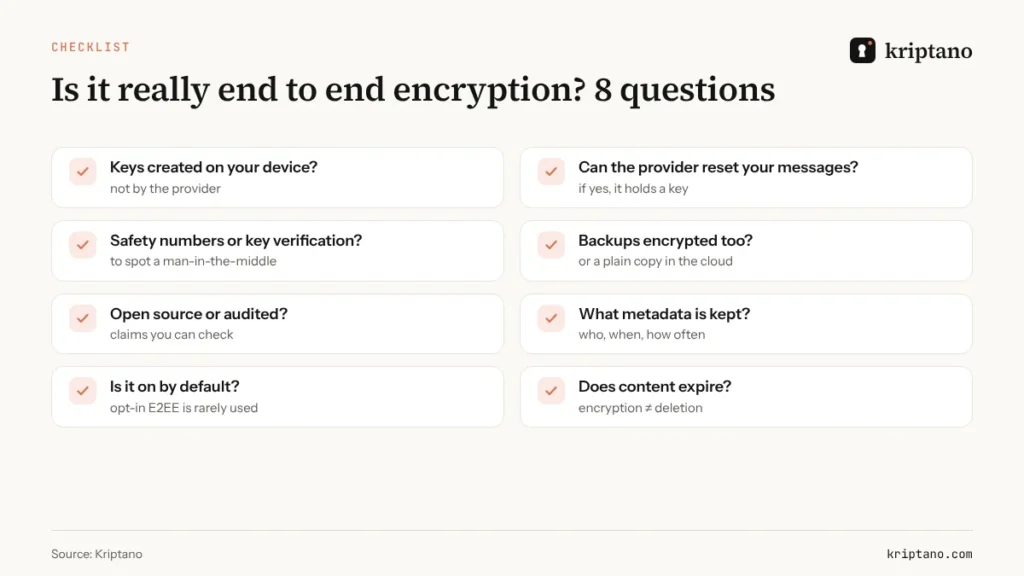
The single most revealing question is the second one. If a provider can help you recover your messages after you forget your password, it must be able to decrypt them – which means the encryption isn’t end to end in the strict sense. That’s not always bad (it’s a usability trade-off), but it should be a conscious choice rather than a surprise you discover during an incident.
Four myths about end to end encryption
“Encrypted means anonymous.” It doesn’t. The content is hidden; your account, phone number and contacts usually are not.
“If it’s encrypted, I can send anything.” A password sent through an encrypted messenger still sits in both chat histories – and in every backup that isn’t encrypted the same way. Encryption protects the journey, not the archive.
“Governments can’t touch encrypted services.” They can’t read the content directly, but they can pressure providers to change the design, as the UK case with Apple’s Advanced Data Protection showed. Policy is part of the threat model.
“Quantum computers already broke it.” Not today. Large-scale quantum computers would threaten today’s public-key algorithms, which is why Signal added a post-quantum key exchange (PQXDH) in 2023 and Apple introduced PQ3 for iMessage in 2024. The symmetric layer – AES-256 – is considered robust against known quantum attacks.
A practical end to end encryption setup for a small team
You don’t need a cryptographer to get most of the benefit. A sensible baseline for a team of five to fifty people looks like this:
- one encrypted messenger for internal chat about anything sensitive, with disappearing messages switched on for channels that discuss credentials or incidents;
- encrypted backups enabled on every phone that holds company chats;
- a business password manager for shared logins, so passwords don’t need to be messaged at all;
- one-time links for secrets that leave the company – to clients, freelancers and new hires;
- a short written rule: “No passwords, ID numbers or health data in email or plain chat.”
That last rule does more than any technology choice, because it removes the habit that puts secrets in the wrong place to begin with.
E2EE and email
Email was designed decades before E2EE and retrofitting it is hard. Proton and Tuta encrypt end to end between their own users; PGP and S/MIME work when both sides set them up. Our comparison of secure email providers explains the options, and how to send an encrypted email covers S/MIME, PGP and the built-in tools in Gmail and Outlook. For anything that only needs to be read once – a password, an account number – a one-time link inside a normal email is often simpler.
What E2EE means for businesses
For a company, E2EE is both a protection and a responsibility. It protects customer data if a provider is breached, and it reduces what a regulator would call the “risk to individuals”. It also means you must think about retention, legal holds and offboarding yourself, because the provider can’t do it for you. Under GDPR and NIS2, encryption is one of the measures regulators expect – our NIS2 and GDPR compliance guide shows how to document it. And when your team shares credentials with clients, a secure password sharing tool with E2EE and an audit log gives you both privacy and proof.
Frequently asked questions
What is end to end encryption in simple terms?
End to end encryption means a message is locked on the sender’s device and can only be unlocked on the recipient’s device. The company running the service only relays locked data it can’t read.
What does E2EE stand for?
E2EE stands for end-to-end encryption. It is used in apps such as Signal, WhatsApp and iMessage, and in tools that send encrypted files and secrets.
What is asymmetric encryption?
Asymmetric encryption uses a key pair: a public key that anyone can use to encrypt data for you, and a private key that only you hold to decrypt it. E2EE systems use it to agree on fast symmetric keys such as AES.
Can end to end encrypted messages be hacked?
The encryption itself is very hard to break, but attackers target the ends instead: malware on a phone, unencrypted backups, stolen devices or tricking the recipient. Protect devices and backups as well.
Is email end to end encrypted?
Normally not – most email is only encrypted in transit and at rest. Proton and Tuta encrypt between their users, and PGP or S/MIME work when both sides set them up.
Are iPhone to Android texts end to end encrypted now?
Since May 2026, RCS messages between iOS 26.5 and the latest Google Messages are being end-to-end encrypted in a gradual beta rollout that depends on carrier support. Plain SMS remains unencrypted.
End to end encryption that also forgets
Your browser encrypts, the recipient reads once, the server deletes. Free, no sign-up.