Disappearing messages and the FTX case: why auto-delete is not a compliance strategy
Prosecutors in the FTX case argued that Sam Bankman-Fried used ephemeral messaging to conceal evidence, and his bail was revoked after private writings reached the press. What the case teaches businesses about disappearing messages.
Contents
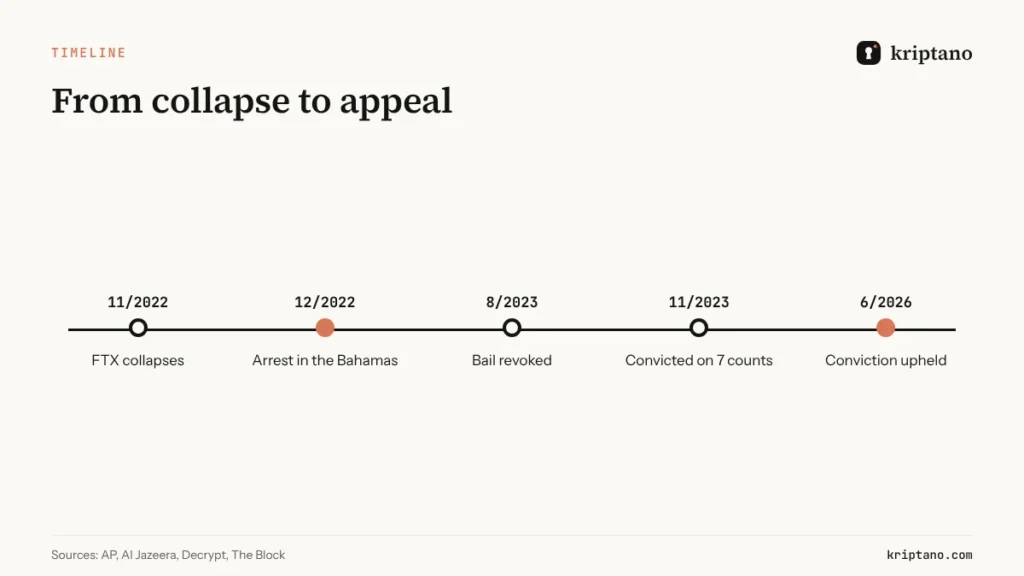
Few cases show the double edge of disappearing messages as clearly as the collapse of FTX. Founder Sam Bankman-Fried was arrested in the Bahamas in December 2022, convicted by a New York jury on seven fraud and conspiracy counts in November 2023 and sentenced to 25 years. In June 2026 a federal appeals court upheld the conviction. Along the way, messaging apps, auto-delete settings and leaked private writings became part of the story.
This article does not retry the case. It looks at a narrower question every company faces: when is ephemeral messaging good security, and when does it become a legal problem?
A note on sources
This article is based on publicly reported court filings and news coverage, listed at the end. Kriptano is not a tool for hiding wrongdoing or evading investigations; it is designed to protect legitimate business secrets such as credentials and personal data.
What happened
Before trial, prosecutors told the court that Bankman-Fried had a pattern of using ephemeral platforms such as Signal and Slack in ways that, in their view, concealed potential evidence of wrongdoing at FTX. At an August 2023 hearing, Judge Lewis Kaplan asked the defense whether he had instructed others to use the delete function; his lawyer replied that it was not for any improper purpose.
The same month, the judge revoked Bankman-Fried’s bail. Prosecutors had shown that he shared private writings of Caroline Ellison – his former partner, former Alameda Research CEO and a key witness – with a New York Times reporter, and that he had earlier contacted the general counsel of FTX US over Signal. The judge found probable cause that he had tried to influence witnesses.
Why auto-delete messages cut both ways
Used properly, auto-delete messages reduce risk: a password that disappears after it is read cannot leak from an inbox two years later. Used to make business decisions vanish, the same feature can create a much bigger problem. Where there is a duty to keep records – financial rules, litigation holds, investigations – deleting can itself be seen as evidence of intent, and in some situations as obstruction.
The FTX case also shows a second lesson: even with auto-delete, the most damaging material is often something else entirely – a shared document, a screenshot, a witness. Nothing about a messaging setting controls what other people keep.
Disappearing messages: what businesses should learn
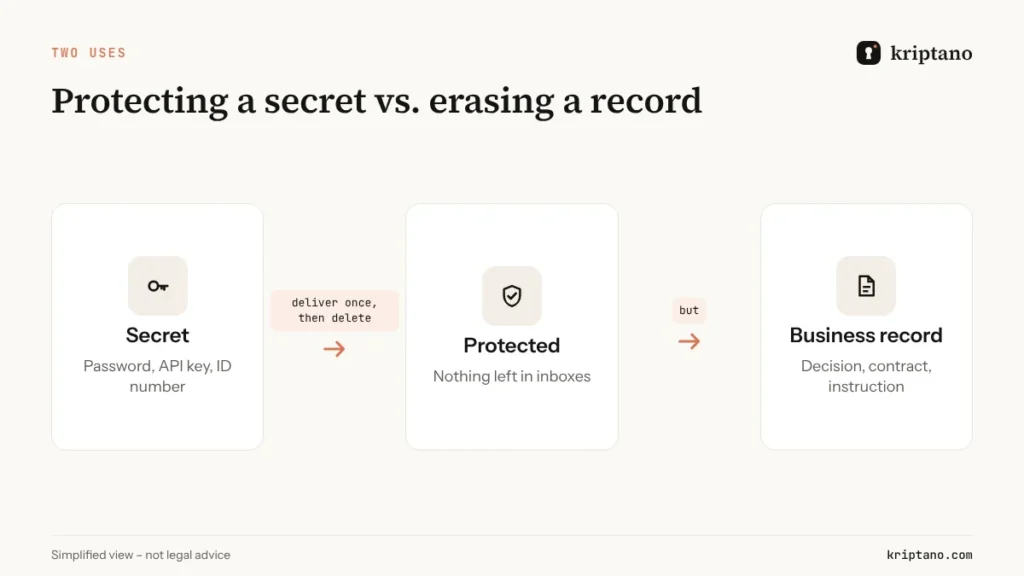
The practical rule is simple: separate secrets from records. Secrets – credentials, one-time codes, personal data you only need to hand over – should not live forever in chats and inboxes. Records – decisions, approvals, contracts, instructions – must be kept according to your legal and regulatory obligations, in systems designed for that.
Where a one-time link helps – and where it does not
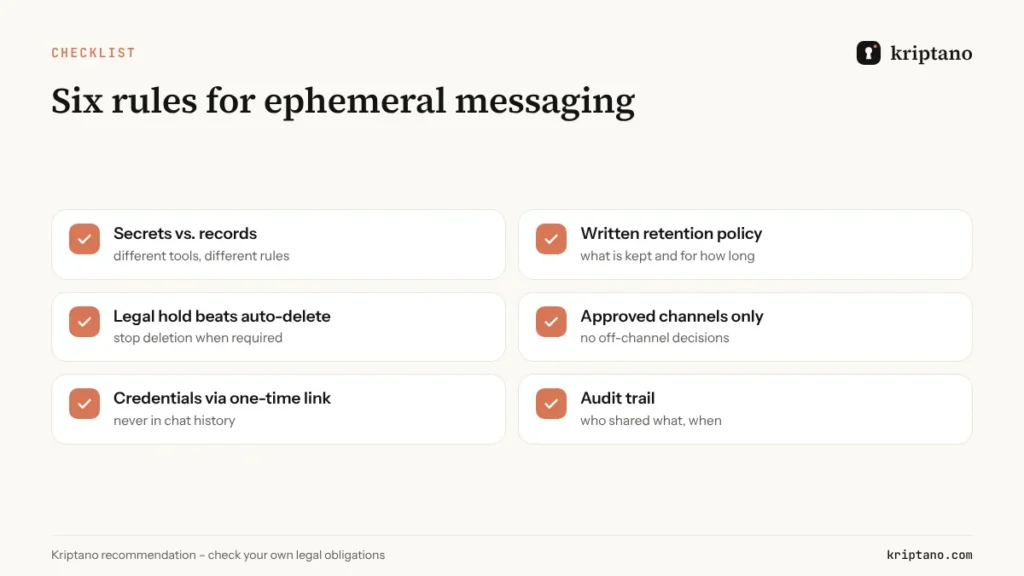
Kriptano is built for the “secret” side of that line. Content is encrypted in your browser, the key stays in the part of the link that is never sent to the server, and the record is deleted after the first view or when it expires. On team plans, an activity log shows when a link was created and opened – without storing the secret itself.
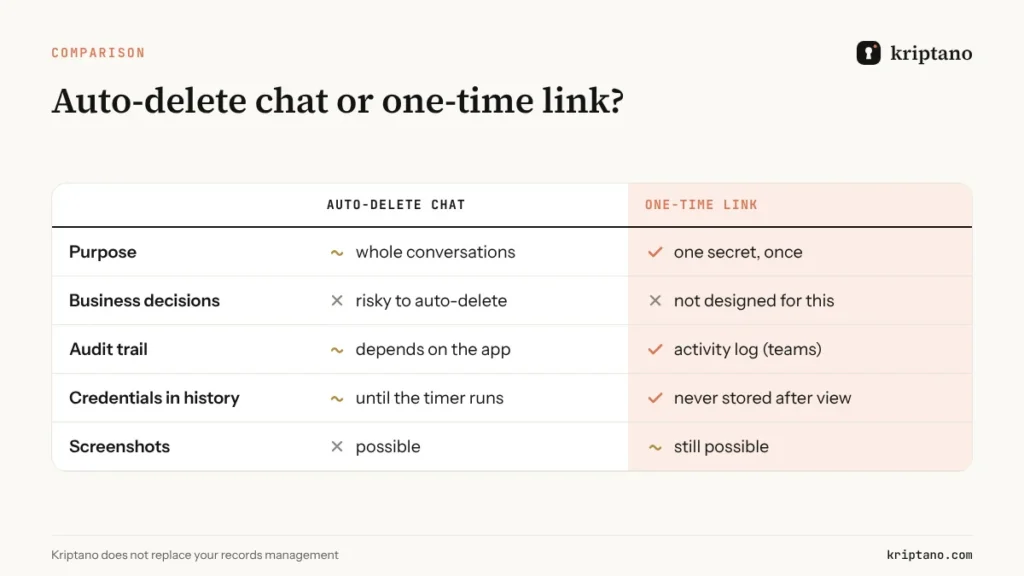
To be clear about the limits: Kriptano cannot stop a recipient from writing down or photographing a secret, and it must not be used to destroy records you are required to keep. We respond to lawful requests in line with applicable law – but we cannot hand over secret content, because we never have the key.
For practical guidance, read how to share passwords securely and what a one-time secret link is. Compliance aspects are covered in our NIS2 and GDPR guide.
Frequently asked questions
Are disappearing messages legal for businesses?
Generally yes, but they must not override record-keeping duties. Regulated industries and companies under a litigation hold may be required to preserve communications. Check your obligations with a lawyer.
What did prosecutors say about messaging in the FTX case?
According to a pre-trial filing reported by Decrypt, prosecutors argued that Bankman-Fried used ephemeral platforms such as Signal and Slack in a pattern that concealed potential evidence. His lawyer said deletion was not for any improper purpose.
Is a one-time link the same as disappearing messages?
Not quite. A one-time link is for handing over a single secret – a password, key or ID number – and it is deleted after the first view. It is not a replacement for business communication or records.
Can Kriptano recover a deleted secret?
No. After the first view or expiry the encrypted record is deleted, and the server never had the key to decrypt it.
Sources
– AP / PBS: Bankman-Fried jailed after judge revokes bail (Aug 11, 2023) – Decrypt: Prosecutors on the Ellison diary leak and ephemeral messaging – Inner City Press: Bail hearing transcript notes – Al Jazeera: Bankman-Fried’s bail revoked – The Block: Appeals court rejects bid for new trial (June 12, 2026)