Confidential Tender Documents: How to Share Them Securely with Bidders and Subcontractors
Site plans, security system layouts and IT architecture rarely belong on a public tender portal – but they don't belong on a USB stick or in an email thread either. How contracting authorities and bidders can exchange confidential tender documents with encryption, expiry and an audit trail.
Contents
- What counts as confidential in a transparent process
- What the rules say about confidential tender documents
- Why USB sticks, email and shared folders fall short
- Sharing restricted procurement documents in 4 steps
- Drawings, plans and models: large files without the hassle
- For bidders: subcontractors, consortia and commercial secrets
- GDPR and NIS2: why buyers increasingly ask
- Checklist: confidential tender documents without leaks
- Frequently asked questions
Confidential tender documents are the awkward exception in modern procurement. Notices, specifications and clarifications live on an e-procurement portal, and bids are submitted there too. Yet almost every larger contract has a part that must not be public: building plans, CCTV and fire-alarm layouts, network diagrams, server inventories or descriptions of legacy systems. That part still travels on USB sticks, DVDs or as email attachments.
This guide explains what EU and UK rules say about confidentiality in procurement, why USB sticks and email create copies nobody controls, and how to share the restricted part of your procurement documents with an expiry date, an access code and an audit trail. The second half is for bidders who exchange prices, references and CVs with subcontractors and consortium partners.
What counts as confidential in a transparent process
Transparency does not mean that everything is public. In practice three groups of information need extra protection:
- Restricted procurement documents – drawings and plans, security and fire-system layouts, network topology, server lists and descriptions of existing applications.
- Parts of a bid that the supplier marks as commercially sensitive – technical solutions, pricing models or internal calculations.
- Personal data of key staff: CVs, degree certificates, professional qualifications and employment references. These are personal data under the GDPR even when they are not trade secrets.
The same rule applies to all three, and to confidential tender documents in general: information should reach only the people who need it, and only for as long as they need it. That is why many tenders have a public part and a restricted part that is released only to bidders who sign a non-disclosure agreement.
What the rules say about confidential tender documents
Within the EU, Directive 2014/24/EU sets the framework that national laws such as Germany’s VgV or Ireland’s procurement regulations transpose:
- Contracting authorities must not disclose information that suppliers designate as confidential, including trade secrets and confidential aspects of tenders (Article 21(1)).
- Authorities may impose requirements on suppliers to protect the confidentiality of information they make available during the procedure (Article 21(2)) – in practice usually a non-disclosure agreement.
- Procurement documents should be available electronically, free and in full. Where an authority withholds part of them to protect confidentiality, the notice must state the protective measures and how access can be obtained, and the deadline for tenders is extended by five days (Article 53(1)).
In the UK, the Procurement Act 2023 has applied to new procurements since 24 February 2025, while procedures started earlier still run under the Public Contracts Regulations 2015, whose regulation 21 mirrors Article 21. Section 94 lets authorities withhold information, for example where it is commercially sensitive, but they must say that something is being withheld. Public bodies are also subject to the Freedom of Information Act, so bidders should mark what they consider confidential.
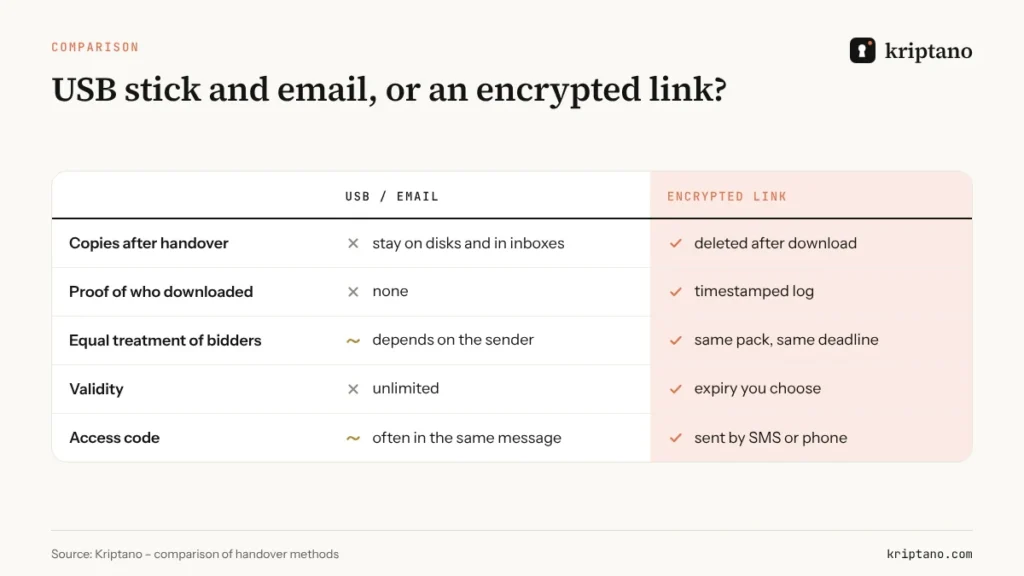
None of these rules prescribe a delivery channel. They prescribe an outcome: confidential tender documents reach authorised bidders only, on equal terms, and you can prove it. That is exactly where USB sticks and email fall short.
Classified information is out of scope
If a contract involves information with a government security classification, defence and security procurement rules, or US Controlled Unclassified Information under NIST SP 800-171, separate requirements apply. This guide covers confidential information that is not classified.
Why USB sticks, email and shared folders fall short
A USB stick gives every bidder a permanent copy that can be duplicated without a trace. Email leaves the attachment in the sender’s sent items, the recipient’s mailbox, both mail servers and their backups – for years after the contract is awarded.
A cloud folder solves the size problem but not the control problem: “anyone with the link” links get forwarded, and access is rarely revoked after the tender deadline. Procurement also rests on equal treatment, so every bidder has to receive the same pack at the same time – and you need to be able to show that if a challenge is brought.
The most common mistakes
- One shared link for all bidders – when it leaks, you can’t tell who leaked it.
- The archive password in the same email as the archive, which defeats the purpose.
- A cloud folder left open for months after bids are opened.
- Answering one bidder privately instead of publishing the clarification to all.
- Sending to personal addresses of staff at the bidding company.
Sharing restricted procurement documents in 4 steps
Confidential tender documents don’t need a USB stick to be protected. Kriptano encrypts files in the buyer’s browser with AES-256-GCM before they leave the computer. The key exists only in the part of the link after the # sign, so the server cannot read the content. After download or expiry the encrypted record is deleted. The process for buyers looks like this:
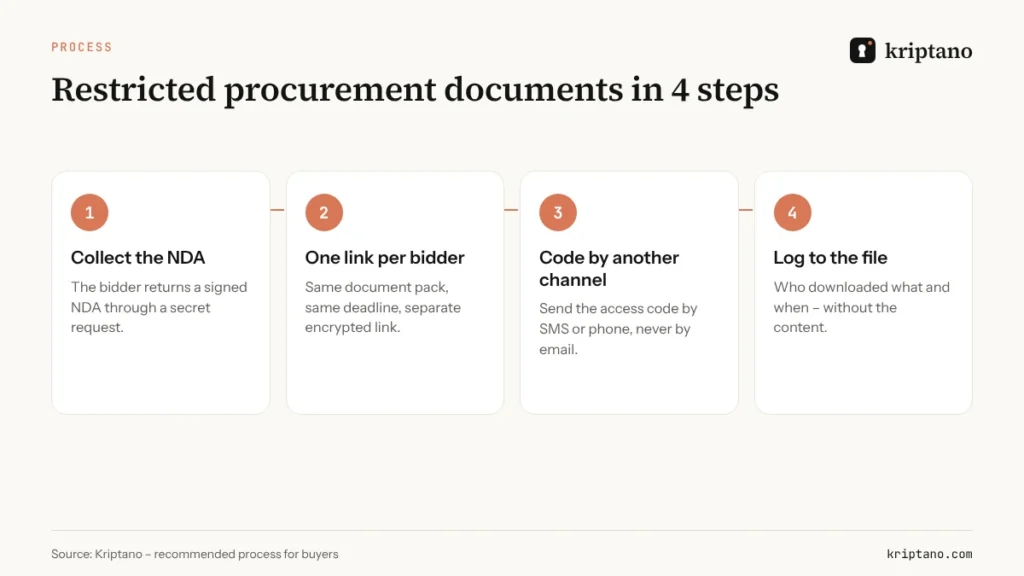
Collect non-disclosure agreements
Send each bidder a secret request; they return the signed non-disclosure agreement as an encrypted attachment.
Create one link per bidder
Same document pack, same expiry and same number of views – but a separate link, so the log shows who downloaded what.
Send the access code by another channel
The link goes by email; the extra passphrase goes by SMS or phone to the contact named in the NDA.
File the audit log
The activity log records when each link was created and opened, without the content, and can be exported to CSV.
The passphrase also protects against a mistyped address: without it the link opens nothing, and after five wrong attempts the secret is destroyed. If a bidder reports that their link no longer works, you know someone opened it first – send a fresh link and find out what happened.
Wording for the contract notice
A short formulation could read: “The restricted part of the procurement documents is available to suppliers who submit a signed non-disclosure agreement. Documents are delivered by encrypted one-time link to the contact named in the agreement; the access code is sent by SMS.” Adapt it to your procedure and check it with your legal team.
Drawings, plans and models: large files without the hassle
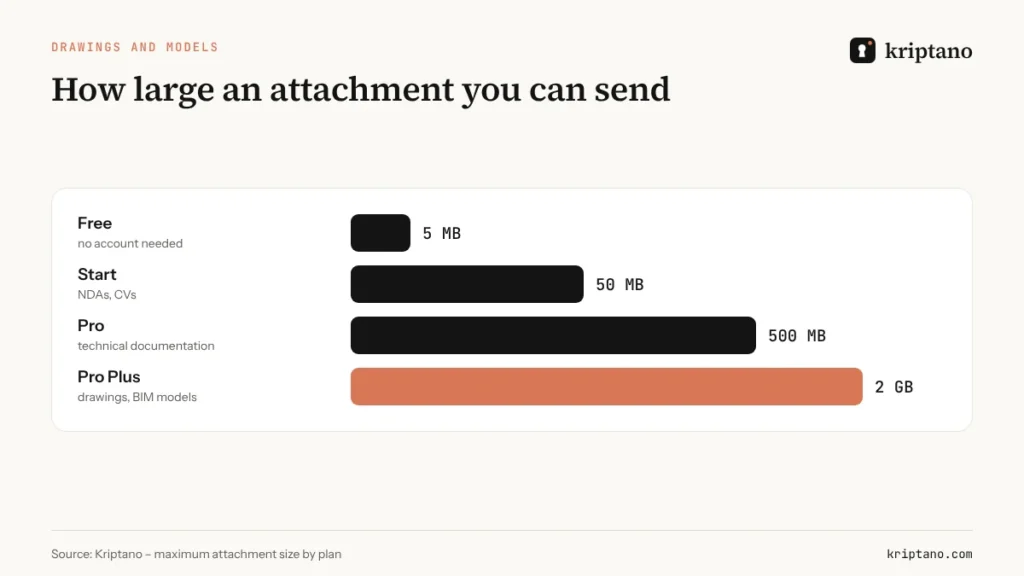
When confidential tender documents cover construction works or complex IT systems, the design files rarely fit in an email. Kriptano sends large files in chunks: each chunk is encrypted separately in the browser and uploaded directly to storage in the EU, so an interrupted upload resumes from the last chunk. The maximum attachment size depends on the plan:
Authorities that send confidential tender documents in several procedures a year also benefit from team features: up to 5 members on Pro and up to 25 on Pro Plus, with roles and mandatory two-factor authentication. On Pro Plus links can sit on your own domain, such as secure.council.gov.example, which helps bidders recognise genuine messages. Plans are compared on the Pricing page.
For bidders: subcontractors, consortia and commercial secrets
Bidders share confidential information just as often as buyers, only at a different stage – while preparing the bid, usually in the last days before the deadline. Typical cases:
- A subcontractor sends prices, a technical solution and references it doesn’t want competitors to see.
- A consortium partner exchanges financial data, contracts and internal calculations.
- Key staff send CVs, degree certificates and qualifications full of personal data.
Who should see subcontractor prices
Subcontractor prices and internal calculations are confidential even inside your own company – only the bid team should see them. Instead of collecting them by email, send each contributor a secret request: they add their documents on the request page, their browser encrypts them, and you download them once. The files never sit in your mailbox, and you know exactly when they arrived. The same pattern works for passwords, as described in our guide to temporary passwords and login credentials.
Bids go through the official portal only
Kriptano is for the restricted part of the procurement documents and for exchanges while preparing a bid. Tenders, clarification questions and challenges go through the channels the procedure requires.
If your bid includes documents in another language, those need to reach the translator securely as well – see our guide on certified translation.
GDPR and NIS2: why buyers increasingly ask
CVs and certificates of key staff contain personal data, so the GDPR (or UK GDPR) applies alongside procurement law: data is processed only for the procedure, protected appropriately – Article 32 explicitly mentions encryption – and not kept longer than necessary. A link that deletes itself after download meets both expectations.
Many contracting authorities are also in scope of NIS2 and now ask suppliers for evidence of supply-chain security. Protected document exchange with an audit log is a concrete measure you can point to. Our guide NIS2 and GDPR compliance covers the wider picture, and Send sensitive documents securely explains encrypted file transfer in general.
Checklist: confidential tender documents without leaks
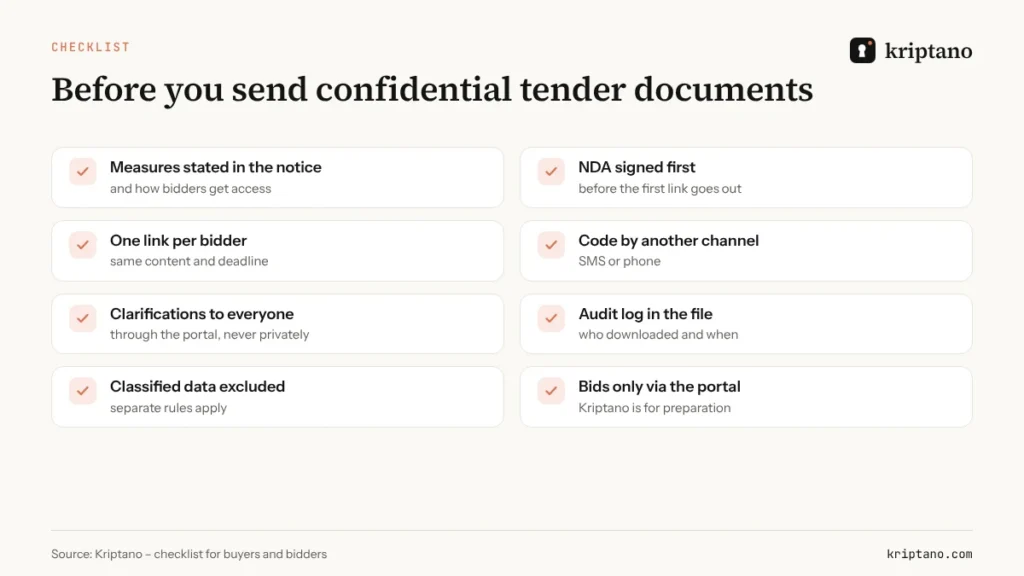
- State the confidentiality measures and how to obtain access in the notice.
- Collect signed non-disclosure agreements before the first link.
- Send each bidder a separate link with the same content and expiry.
- Send the access code by another channel, never in the same message.
- Publish questions and answers to everyone through the portal, never privately.
- Keep the download log in the procurement file.
- Exclude classified information – separate rules apply.
- After the deadline, check who did not download the documents and why.
Frequently asked questions
Can confidential tender documents be sent by email?
The rules don’t prescribe a channel, but they require confidential information to be protected and available to bidders on equal terms. A plain attachment leaves permanent copies and gives no proof of download, so an encrypted link with an expiry and access code is the safer choice.
Is a non-disclosure agreement enough on its own?
An NDA binds the bidder, but it doesn’t protect the file in transit or in a mailbox. Combine it with a technical measure: an encrypted link, a short expiry and an access code.
Can bids be submitted through Kriptano?
No. Tenders are submitted only through the e-procurement portal named in the notice. Kriptano is for the restricted part of the procurement documents and for exchanges with subcontractors while preparing a bid.
How do I prove a bidder downloaded the documents?
The activity log on Pro and Pro Plus records when each link was created and opened. You can export it to CSV and keep it in the procurement file.
Can I send drawings several hundred megabytes in size?
Yes. Files are encrypted in chunks; the maximum attachment size is 500 MB on Pro and 10 GB on Pro Plus.
Restricted documents without the USB stick
Your first link is free and needs no account. When procurement calls for large attachments, an audit log and a team, choose a plan.